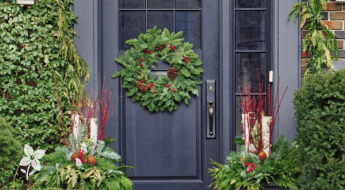
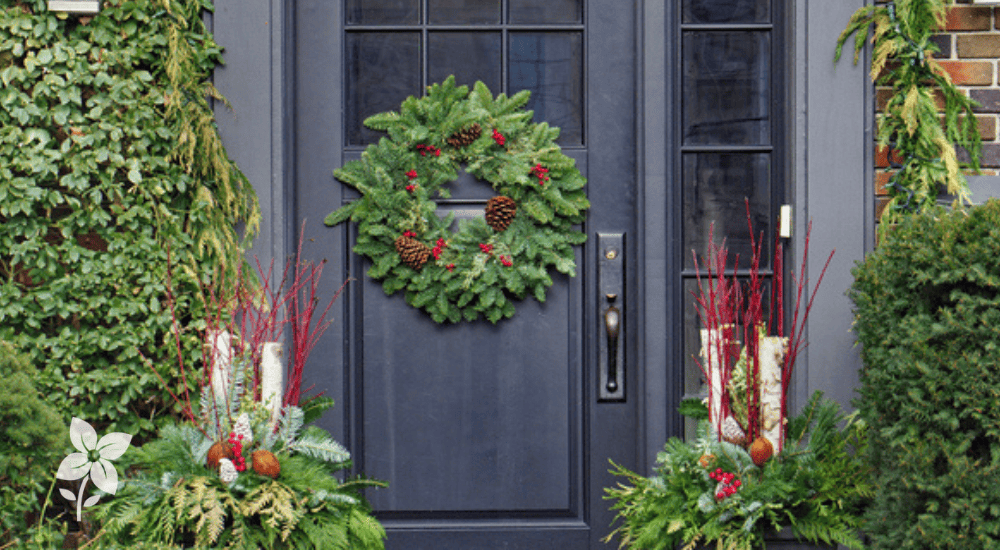
Most winter planter ideas are built for December’s festive celebrations, and the front step gives the game away by the second week of January. The wreath has come down, the inflatable snowman folded into a storage bin, and the planter by the door is still wearing glitter picks and a satin bow bleached pale by the low winter sun. It looks like a stage with the lights still on and no performer left.
The trouble is not a lack of effort. It is a matter of timing. Many arrangements are designed to peak on Christmas Day, with nothing planned for the long, pale weeks that follow, when an Alberta winter is still firmly in charge and the porch is the first thing you see coming home in the late-afternoon dark.
The fix is a planter built on things that last: strong structure, natural texture, and colour used with restraint. Evergreens, red stems, white bark, and weathered cones carry a container from late November to the first hint of spring melt without asking for much in return. Here is how to build one that looks as good in February as it did in December.
Why Most Winter Planters Fade After Christmas
Holiday containers tend to lean on the loudest materials in the store: glitter-dusted sprays, metallic picks, velvet bows, and baubles in candy-apple red. On December 20, that brightness feels right. By January 10, the same pieces read as leftovers. Glitter sheds into the snow, fabric ribbon fades and frays, and anything Santa-themed starts to look like a party guest who missed the cue to leave.
Structure outlasts sparkle. A planter anchored by branches, boughs, and stems holds its meaning whether the calendar says Christmas Eve or Family Day. Form is the long game; festivity is a single season within it.
There is also a practical argument. Once soil freezes in a container, it locks everything in place, so pulling out the Christmas pieces and rebuilding in January is rarely possible without a chisel and a lot of patience. Designing for the whole season from the start means you buy materials once, build once, and enjoy the result for three months instead of three weeks. It is the more economical choice, and almost always the more elegant one.
Winter Planter Ideas That Last: Building Blocks of an Enduring Design
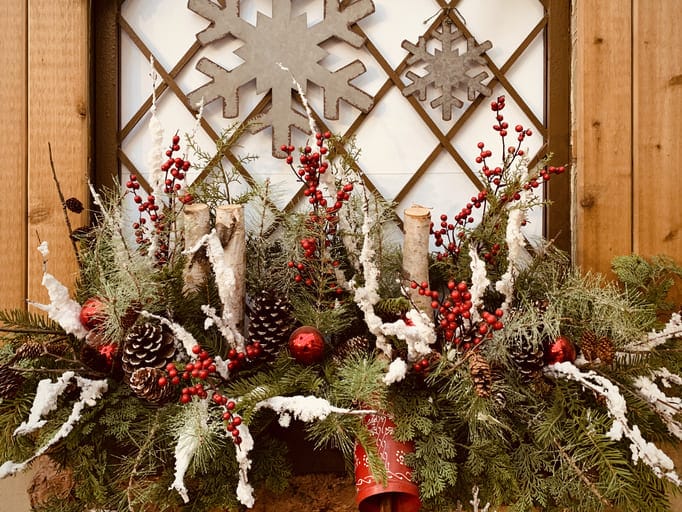
Think of a lasting winter container in layers: a backbone of evergreens, vertical lines of coloured stems and pale branches, and fine details that reward a closer look. Each layer earns its place.
Evergreen Branches: The Living Backbone
Evergreen boughs are the arrangement’s green bones. They give fullness, hide the soil, soften the rim of the pot, and release a resinous scent every time you brush past on the way to the door. Most garden centres sell mixed bundles, but choosing species deliberately makes a real difference to how the planter ages.
Spruce is the workhorse. White spruce and Colorado blue spruce have stiff, sturdy branches that hold up well in steady cold, and their silvery blue adds a cool note that complements red stems beautifully. Balsam fir is soft, dense, and fragrant, and it is one of the better choices for needle retention. White pine brings long, feathery needles and a looser, more relaxed silhouette. Cedar offers flat, lacy sprays that hang gracefully over the edge, though it can bronze or dry out in full sun and wind, so it does its best work in a sheltered or north-facing spot.
Two habits improve longevity. First, recut the stems at an angle and soak the boughs overnight in a bucket of cold water before arranging so they go into the planter fully hydrated. Second, consider an anti-desiccant spray, applied in a garage or on a mild day according to the label directions. It can slow moisture loss from needles exposed to drying winter wind.
If you are collecting evergreen planter ideas, notice that the strongest designs rarely rely on a single species. Combining two or three species, such as blue spruce for structure, fir for fullness, and cedar for drape, creates depth that a uniform green mass cannot match.
Red Twig Dogwood: Colour That Refuses to Retreat
When everything else has gone grey, white, and brown, red twig dogwood keeps burning. Its stems are the best way to add colour to a winter container without a single ornament, and the hue increases as temperatures drop.
Red osier dogwood (Cornus sericea) is native across Alberta, and cultivars like ‘Cardinal’ offer especially bright stems. Tatarian dogwood (Cornus alba), including ‘Sibirica’, leans toward deep crimson. For a warmer palette, choose the coral and orange stems of Cornus sanguinea ‘Midwinter Fire’, or add yellow twig dogwood (‘Flaviramea’) for lively contrast against dark spruce.
In a red twig dogwood winter planter, the stems usually stand in the centre or toward the back, rising above the evergreens in a loose fan. Bundles of five to nine stems read more confidently than scattered singles. As a rough guide, the tallest stems should reach about 1.5 to 2 times the height of the container, giving the arrangement presence without making it top-heavy in the wind.
If you grow dogwood, you can harvest your own. The brightest colour is on younger stems, roughly one to three years old, so cut those, take only a few from each shrub, and spread the cuts around the plant to keep its shape.
Birch Branches: Pale Poetry
Birch adds what evergreens cannot: clean vertical lines and pale, papery bark that glows in low light, nearly vanishes against fresh snow, and reappears when the sky clears. A cluster of three birch poles at staggered heights gives a planter architectural structure, the way columns give a doorway its dignity.
Buy birch poles and branches from a garden centre or florist rather than cutting from living trees, since stripping bark or removing limbs from healthy birches stresses them. Look for poles with intact bark and a mix of thicknesses. Tuck finer birch tips, the twiggy upper growth, among the evergreens to add a soft haze between the bold dogwood stems and the dense greens. If birch is hard to find, curly willow offers a similar sculptural quality with a more playful line.
Birch partners well with almost everything else on this list. White bark beside red stems is a classic winter pairing for good reason: the contrast is crisp, natural, and readable from the sidewalk.
Cones, Seed Heads, and Berries: Texture That Tells a Story
Up close, a good winter planter should reward a second look. This is where smaller natural details come in, catching frost in the morning and holding little ridges of snow by afternoon.
Lodgepole pine, Alberta’s provincial tree, produces small, tight cones that sit neatly among boughs, while spruce cones are slender and elegant. For larger accents, florists often carry big cones from western pines. To secure them, wrap floral wire around the lower scales, twist the ends together, and attach them to a wooden floral pick or a solid stem you can push into the soil.
Seed heads bring the garden’s own memory into the container. Purple coneflower, black-eyed Susan, sedum ‘Autumn Joy’, and dried hydrangea blooms such as ‘Annabelle’ or ‘Limelight’ hold their shape well into winter. Dried lotus pods, available from floral and craft suppliers, add bold sculptural rounds. Ornamental grass plumes look lovely but tend to shatter in strong wind, so treat them as short-term guests.
Berries supply restrained colour. Cut winterberry holly stays bright when frozen, but it can soften during a thaw, and birds may strip it, which some gardeners count as a bonus. High-quality weatherproof faux berries are a dependable alternative when you want the colour to stay put.
Durable Accents: Restraint as a Design Principle
The final layer is the one most likely to go wrong because it is where the temptation to add more lives. Restraint is the rule. One or two well-chosen accents will do more than a dozen small ones.
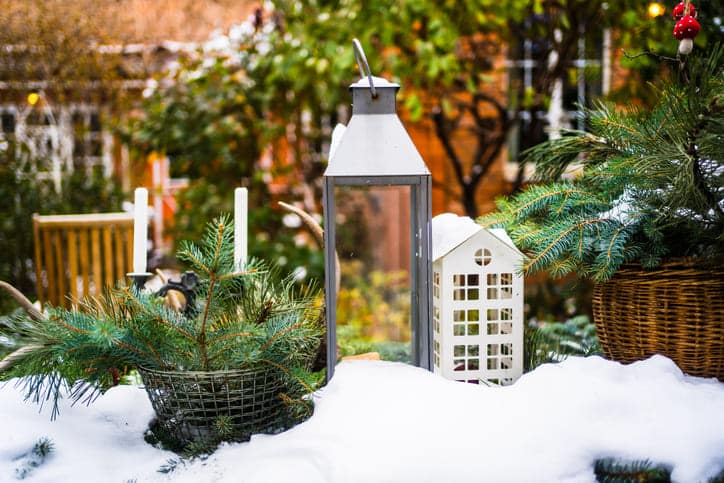
Choose materials that shrug off moisture and cold: galvanized or copper lanterns, wooden stars, birch-log slices, rusted-metal shapes, and shatterproof ornaments. Glass ornaments are fragile in wind and break easily when they knock against frozen branches, while paper, felt, and many fabric ribbons absorb meltwater, sag, and fade. If you love ribbon, choose wired, weather-resistant styles in natural tones like charcoal, cream, or moss green that still look at home in February.
Keep accents in the same visual family. A metal lantern, a few wood slices, and the natural materials already in the pot speak one language. Add a glittered snowflake and a plush reindeer, and suddenly the conversation turns awkward.
Winter Planter Ideas for the Holidays and Beyond
None of this means giving up festive sparkle. It simply means treating holiday decorations as temporary guests, not permanent residents.
The trick is making them easy to remove. Once the soil freezes, anything pushed into it won’t come out cleanly. So when you build in November, slip a few short lengths of plastic tubing or wide drinking straws into the soil among the greens. They freeze in place and become sleeves, letting holiday picks slide in for December and lift out in January without disturbing the arrangement. Wire ornaments onto branch tips and tie ribbons around dogwood bundles rather than burying their ends. For lights, battery-operated LED strings with a built-in timer are simple to thread through boughs, and lithium batteries generally hold up better than alkaline ones in deep cold.
Before: In December, the planter is dressed for celebration. A plaid ribbon wraps the dogwood, a cluster of red-and-gold shatterproof balls nestles in the fir, and warm white lights shine through the spruce at dusk.
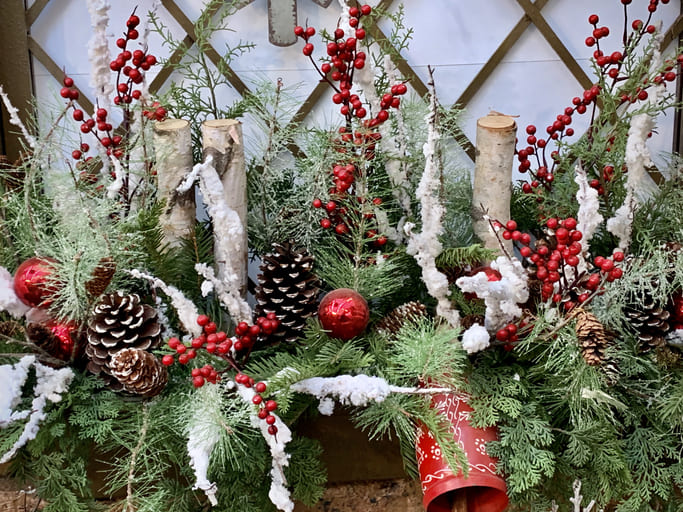
After: In early January, you take out the ribbon and baubles. What remains is quieter and, arguably, more beautiful: crimson stems against white birch, layered greens catching snow, cones and seed heads dusted with frost. You can leave the lights on if you like, since February evenings are still long and a mild glow by the door never feels out of date. At this point, it is simply winter porch decor, no longer dependent on the holidays to make sense.

How to Build a Winter Planter That Survives Alberta’s Cold
Much of the winter container advice online is written for places where January means a few frosty mornings. Here, a planter must stand up to minus 30 nights, wind that crosses the prairie unopposed, heavy wet snow, and, in many areas, chinook swings that thaw everything and lock it back up overnight. Construction matters as much as design.
- Time it right. Replace finished autumn containers in late November, once frost has taken the annuals but before the potting soil freezes solid. In central and northern Alberta, that window can close early, so watch the forecast and be ready to move. If the soil has already frozen, bring the pot into a garage for a day or two, or scrape off the top layer and replace it with fresh, unfrozen potting mix. Remove spent annuals, roots and all, to make room for stems.
- Prepare the container. Choose a pot that can handle freezing: fibreglass, resin, metal, thick cast concrete, or wood. Terracotta and thin glazed ceramic often crack when wet soil freezes and expands. Make sure the drainage hole is open and remove any saucer, which quickly becomes an ice tray. A container at least 35 to 40 cm (14 to 16 in) across holds enough soil to anchor tall stems and enough weight to resist tipping.
- Set the foundation. Fill the container with potting soil to about 5 cm (2 in) below the rim and press it down firmly. In very large pots, you can fill the bottom with an upturned nursery pot to save on mix, as long as the top 25 to 30 cm (10 to 12 in) is real soil. Water thoroughly so that it is evenly moist throughout. Moist soil freezes into a solid block that grips stems like concrete, while dry, fluffy mix freezes loose and lets them wobble.
- Build from tall to low. Recut every stem at an angle just before it goes in. Start with the structural pieces: dogwood bundles and birch poles in the centre of a pot viewed from all sides, or toward the back of one set against a wall. Push them 15 to 20 cm (6 to 8 in) deep. Next, add the evergreens, starting with draping pieces like cedar or white pine angled down over the rim, then spruce and fir to fill in until no soil shows. Finish with cones, seed heads, berries, and accents, placed where they will catch the eye and the light.
- Anchor against wind. The wind will test every stem you place, usually on the first gusty night. Answer it with depth and density. Pack branches tightly so they support one another, and bind tall dogwood or birch bundles with a zip tie or floral wire, hidden among the greens. In exposed spots, a length of rebar or a strong stake pushed to the bottom of the pot gives tall elements something to lean on. When the arrangement is complete, water once more to settle soil around every stem, and let the first hard freeze lock it in.
- Plan for freeze-thaw. Frost may settle quietly on the planter, but freeze-thaw cycles are the real stress test. When a chinook or mild spell softens the soil, stems can lean or slip, and when the cold returns, they freeze at whatever angle the thaw left them. Water expanding in saturated soil can also lift stems and press against the pot walls. Firm placement and good drainage help: tightly packed, deeply set stems have little room to shift, and freely draining soil holds less water to expand. After a thaw, straighten anything that has tilted and press the soil down before the next freeze. If heavy snow weighs down the boughs, brush it off gently with a broom rather than shaking the branches, which turn brittle in deep cold.
Quick Answers About Outdoor Winter Planters (FAQ)
When should I make a winter planter?
Build it in late November, once autumn containers are finished but before the potting soil freezes solid. In Alberta, that window can close quickly, so watch the forecast. If the soil is already frozen, move the pot into a garage to thaw, or replace the top layer with fresh, unfrozen potting mix.
What can I put in an outdoor winter planter?
Start with cut evergreens such as spruce, fir, pine, and cedar, then add height with red twig dogwood or birch branches. Finish with cones, dried seed heads, and berries for texture. Weatherproof accents like metal lanterns, wood slices, and shatterproof ornaments hold up better than glass, paper, or delicate ribbon.
How long do winter planters last?
A well-built winter planter usually looks good from late November into March in cold climates because steady freezing keeps cut evergreens from drying out quickly. Spruce and fir tend to hold their needles longest. Expect some fading in sunny, windy spots, and tuck in a few fresh boughs during a mild spell if needed.
Do winter planters need watering?
Water thoroughly once, right after building, so the soil freezes into a solid block that holds every stem in place. After that, winter does the work. In a long mild spell, a little water can help evergreens stay fresh, but never water heavily, since soggy soil can crack the pot when it refreezes.
Can I leave a planter outside in winter?
Yes, if the container is frost-resistant and drains well. Fibreglass, resin, metal, cast concrete, and thick wood handle Alberta winters. Terracotta and thin ceramic often crack as wet soil freezes and expands. Lifting the pot onto feet keeps the drainage hole clear, and a plastic liner makes spring cleanup easier.
February Rewards the Patient Planner
Picture the same front step in early February. The holiday decorations are long gone, but the planter by the door still has something to say: red stems lit by the late-afternoon sun, white birch standing like a quiet sentinel, spruce and fir holding a fresh layer of snow. It no longer looks like an empty stage. It looks like it belongs to the season.
December delights, but February rewards the patient planner. The difference comes down to choices made in late November: lasting structure, natural texture, restrained colour, and a foundation the wind cannot shake.
Ready to bring these winter planter ideas to your own front step? Visit Salisbury Greenhouse in Sherwood Park or St. Albert for everything your planter needs, from fresh evergreen boughs and red twig dogwood to birch poles, cones, and weatherproof accents. If you would rather leave the cold work to us, our custom residential planter service creates winter containers tailored to your home and style. With our seasonal switchovers, we’ll pick up your planters, let our designers give them a fresh look, and deliver them back to your door. Request a free quote today. And when your planter is finished, share a photo with us on Facebook or Instagram. We’d love to see it!